
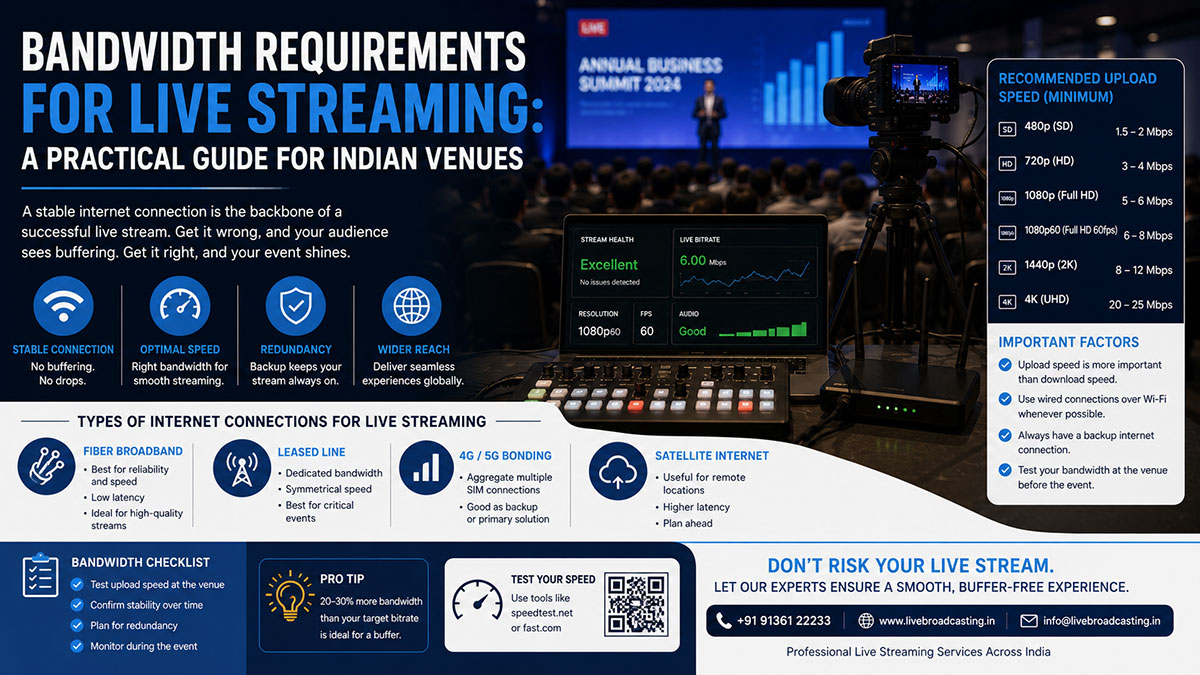
Of all the technical questions that determine whether a live stream succeeds or fails, bandwidth is the most critical and the most frequently misunderstood. Event organisers routinely assume that a hotel’s ‘high-speed Wi-Fi’ or a convention centre’s ‘business broadband’ is adequate for streaming. It is often not.
Understanding Bandwidth — Upload vs Download
Live streaming is entirely about upload speed — how fast your device can push data to a streaming server. Many Indian business internet connections offer asymmetric speeds with significantly lower upload than download. Always test upload speed — not download speed — when assessing a venue’s suitability for live streaming.
Bandwidth Requirements by Stream Quality
720p (HD) Single Camera Stream
Minimum upload required: 4-5 Mbps sustained. Recommended with headroom: 8 Mbps. Suitable for: webinars, internal communications, small conferences.
1080p (Full HD) Single Camera Stream
Minimum upload required: 6-8 Mbps sustained. Recommended with headroom: 12 Mbps. Suitable for: corporate events, conferences, educational events, funeral streaming.
1080p Multi-Camera Stream (2-3 Cameras, Single Output)
Minimum upload required: 8-10 Mbps sustained. Recommended with headroom: 15-20 Mbps. Note: multi-camera production with a hardware switcher still produces a single output stream.
Simultaneous Multi-Platform Streaming (Simulcast)
Minimum upload required: 15-25 Mbps sustained. Recommended with headroom: 35-40 Mbps. Each simultaneous platform destination requires its own stream.
4K (Ultra HD) Live Stream
Minimum upload required: 20-25 Mbps sustained. Recommended with headroom: 40 Mbps. Suitable for: premium brand events, ad film production, flagship corporate productions.
The Indian Venue Reality — What to Expect
Five-Star Hotels and Convention Centres
Premium hotel properties in metro cities typically have reasonably robust business broadband infrastructure. However, shared business centre connections and venue Wi-Fi are shared resources. Always request a dedicated, uncontended wired ethernet connection for your streaming equipment. Never rely on venue Wi-Fi for live streaming.
Tier-2 and Tier-3 City Venues
A venue in Coimbatore, Bhopal, or Kochi may have broadband nominally rated at 100 Mbps but delivering only 8-12 Mbps of sustained upload speed. For events in tier-2 and tier-3 cities, always conduct an on-site connectivity test before the event.
Outdoor Venues, Marquees, and Open Grounds
Outdoor events typically have no fixed internet infrastructure. Bonded cellular streaming is the standard solution for these locations, combining multiple 4G and 5G SIM cards across different networks.
How to Test Your Venue’s Bandwidth Correctly
- Test at the location where your streaming equipment will be physically placed — not at the venue reception
- Test at the time of day the event will take place
- Use fast.com or speedtest.net for basic speed tests
- Run your speed test for at least 5 minutes to assess stability
- Record upload speed, download speed, latency (ping), and packet loss
Solutions for Venues with Inadequate Bandwidth
Bonded Cellular Streaming
A four-SIM bonded setup using Jio, Airtel, Vi, and BSNL can deliver 40-60 Mbps of combined upload bandwidth from most locations in India.
Hybrid Connectivity Setup
The most resilient configuration combines a primary wired connection with a secondary bonded cellular backup. If the primary connection degrades or fails, the encoder automatically switches to the cellular backup without interrupting the stream.
Frequently Asked Questions
Q: Does the number of cameras affect my bandwidth requirement?
Not directly. Multi-camera setups with a hardware switcher produce a single output stream, so bandwidth is determined by your output stream quality, not camera count.
Q: Can I use 4G as a primary connection for an important event?
A single 4G connection is not recommended as a primary streaming connection due to variability in speed and reliability. Bonded cellular — multiple SIM cards combined — is significantly more reliable.
Q: What is packet loss and why does it matter for live streaming?
Packet loss occurs when data packets sent over the internet fail to reach their destination. Even small amounts of packet loss (above 1-2%) cause visible quality degradation in live streams, including pixelation, freezing, and audio dropout.
