
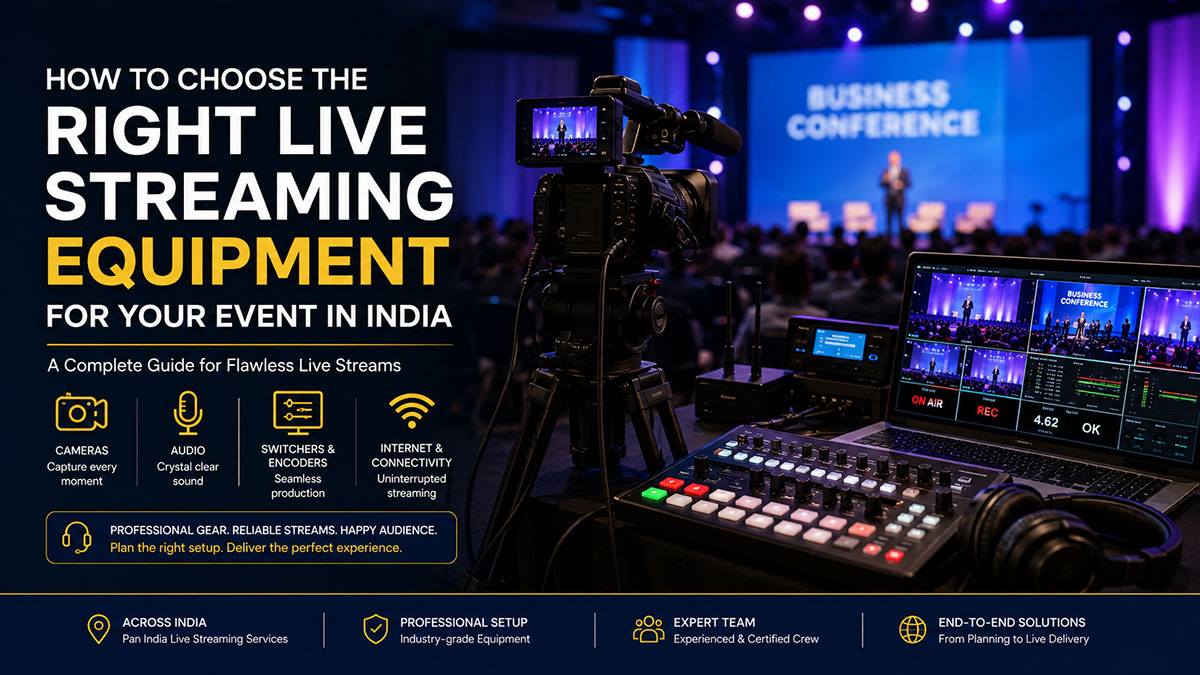
Live streaming an event in India is no longer a novelty — it is an expectation. Whether you are organising a corporate product launch in Mumbai, a wedding reception in Jaipur, or a sports tournament in Bangalore, your remote audience expects broadcast-quality video and uninterrupted audio. The challenge? The market is flooded with options, and choosing the wrong gear can turn a carefully planned event into a buffering disaster.
This guide walks you through every piece of live streaming equipment you need to consider, from cameras and encoders to microphones, switchers, and internet infrastructure. By the end, you will know exactly what to ask for — or why it makes more sense to partner with a professional streaming service in India.
Why Equipment Choice Defines the Viewer Experience
Most event organisers focus on the venue, the speakers, and the catering. The live stream is often treated as an afterthought — until the video freezes in front of 5,000 online viewers. Research from Conviva consistently shows that viewers abandon streams within 90 seconds of a buffering event. In India’s competitive media landscape, a poor-quality stream can permanently damage your brand’s credibility.
Equipment quality directly determines three things: video resolution, audio clarity, and stream stability. Get one wrong, and your online audience notices immediately.
Camera Selection — The Most Visible Decision You Will Make
The camera is the first thing viewers see. Your choice of camera depends on the type of event, the venue size, and your target resolution.
PTZ Cameras (Pan-Tilt-Zoom)
PTZ cameras are the workhorses of professional event streaming in India. They can be controlled remotely, making them ideal for conferences, town halls, and religious ceremonies where a camera operator would be intrusive. Leading models from Sony, Panasonic, and Marshall deliver 1080p at 60fps with low latency HDMI and SDI outputs.
Best for: Corporate conferences, AGMs, webinars, cultural ceremonies, funeral streaming.
Broadcast-Grade Camcorders
For events that require a roving camera operator — weddings, sports, music festivals — broadcast-grade camcorders from Sony, Canon, and Blackmagic Design offer superior optical zoom, built-in ND filters, and professional XLR audio inputs. The Sony PXW series is particularly well regarded for Indian outdoor events because of its ability to handle the harsh contrast between bright daylight and indoor artificial lighting.
Best for: Weddings, sports events, outdoor concerts, election rallies.
Cinema Cameras for Premium Productions
For brand events, IPO roadshows, and high-value corporate productions, cinema cameras like the Blackmagic URSA Mini Pro or Sony FX6 deliver a cinematic look that standard broadcast cameras cannot replicate. These are paired with prime lenses and controlled colour grading for maximum visual impact.
Best for: AD film production, premium brand launches, high-budget corporate events.
Encoders — The Brain of Your Live Stream
An encoder takes the camera’s video signal and converts it into a digital stream that can be sent over the internet. This is where many DIY setups fail completely.
Hardware Encoders vs Software Encoders
Hardware encoders — dedicated devices from manufacturers like Teradek, Matrox, and LiveU — are the gold standard for professional events. They offer H.264 and H.265 encoding, redundant stream paths, and bonded cellular connectivity. A hardware encoder does not share CPU resources with your operating system, which means it will not crash during a critical moment.
Software encoders like OBS Studio are free and genuinely capable for casual streaming. However, they depend entirely on the host computer’s performance, the quality of the internet connection, and the skill of the operator. For a corporate or institutional event, the risk of a single point of failure is unacceptable.
Bonded Cellular Encoders — Essential for Outdoor Events in India
India’s fibre internet coverage, while growing rapidly, is still inconsistent across tier-2 cities and outdoor venues. Bonded cellular encoders like the LiveU Solo or Teradek Cube bond multiple 4G/5G SIM cards together to create a single reliable stream. This is non-negotiable for election rallies, outdoor weddings, sports events, and any situation where a venue does not have guaranteed broadband access.
Audio Equipment — The Most Underrated Component
Viewers will tolerate slightly pixelated video. They will not tolerate poor audio. Audio is the single most critical component of viewer satisfaction, yet it receives the least attention in most DIY streaming setups.
Microphone Types for Different Event Scenarios
Lavalier (lapel) microphones are ideal for keynote speakers and panellists. Wireless systems from Sennheiser, Rode, and Shure offer 2.4GHz or UHF transmission, giving speakers the freedom to move without trailing cables. For panel discussions, table boundary microphones or gooseneck microphones on podiums deliver clean pickup for multiple speakers.
For large audiences and outdoor events, directional boom microphones on camera rigs and dedicated audience microphones ensure that ambient sound is captured cleanly without feedback or wind noise.
Audio Mixers and Interfaces
All audio sources — microphones, musical instruments, playback devices — need to be routed through a professional audio mixer before reaching the encoder. The Yamaha TF series and Allen & Heath Qu series are popular in the Indian professional events market, offering digital mixing, built-in effects, and direct USB streaming outputs.
Video Switchers — For Multi-Camera Productions
Any event with more than one camera requires a video switcher (also called a vision mixer) to cut between camera angles in real time. The ATEM Mini series from Blackmagic Design has become the entry point for professional event streaming in India, offering up to 8 HDMI inputs, direct streaming output, and a built-in audio mixer.
For large-scale productions — IPL-style sports events, national conferences, political rallies — broadcast-grade switchers from Grass Valley, Sony, or Blackmagic ATEM Constellation handle dozens of sources simultaneously with zero-latency switching.
Internet Connectivity — The Make-or-Break Factor in India
No amount of high-quality camera equipment can save a stream if the internet connection is unstable. This is the single biggest challenge for live streaming in India, and it requires careful advance planning.
Calculating Your Bandwidth Requirements
A standard 1080p live stream requires approximately 6-8 Mbps of upload bandwidth. A 4K stream requires 20-25 Mbps. For multi-camera productions with multiple streams, multiply accordingly. Add at least 30% headroom for network fluctuations.
Backup Connectivity — Non-Negotiable for Professional Events
Every professional streaming setup should have at least two independent internet sources: primary broadband/fibre and a backup bonded cellular connection. Livebroadcasting.in’s standard event packages include redundant connectivity to ensure zero-downtime streaming regardless of ISP issues.
Frequently Asked Questions
Q: What is the minimum internet speed required for live streaming an event in India?
For a single-camera 1080p live stream, you need a minimum of 8 Mbps sustained upload speed. For multi-camera productions, plan for 20-30 Mbps. Always verify speed at the venue before the event.
Q: Can I use a smartphone for live streaming a corporate event?
Smartphones can stream, but they are not suitable for professional corporate events. They lack redundancy, professional audio inputs, and reliable low-latency encoding. For business events, use dedicated hardware.
Q: How many cameras do I need for a conference live stream?
A minimum of two cameras is recommended: one wide shot and one medium shot of the stage or speaker. Three to four cameras provide full coverage for multi-session conferences.
Q: What is a bonded cellular encoder and why does India need it?
A bonded cellular encoder combines multiple mobile data connections (e.g., three 4G SIM cards) into a single high-speed, redundant internet path. This is critical in India where fixed broadband availability at outdoor venues is unreliable.
Q: Is it better to buy or rent live streaming equipment for events?
For organisations streaming fewer than 10-12 events per year, managed professional services are more cost-effective. Buying requires capital investment, operator training, and ongoing maintenance.
