
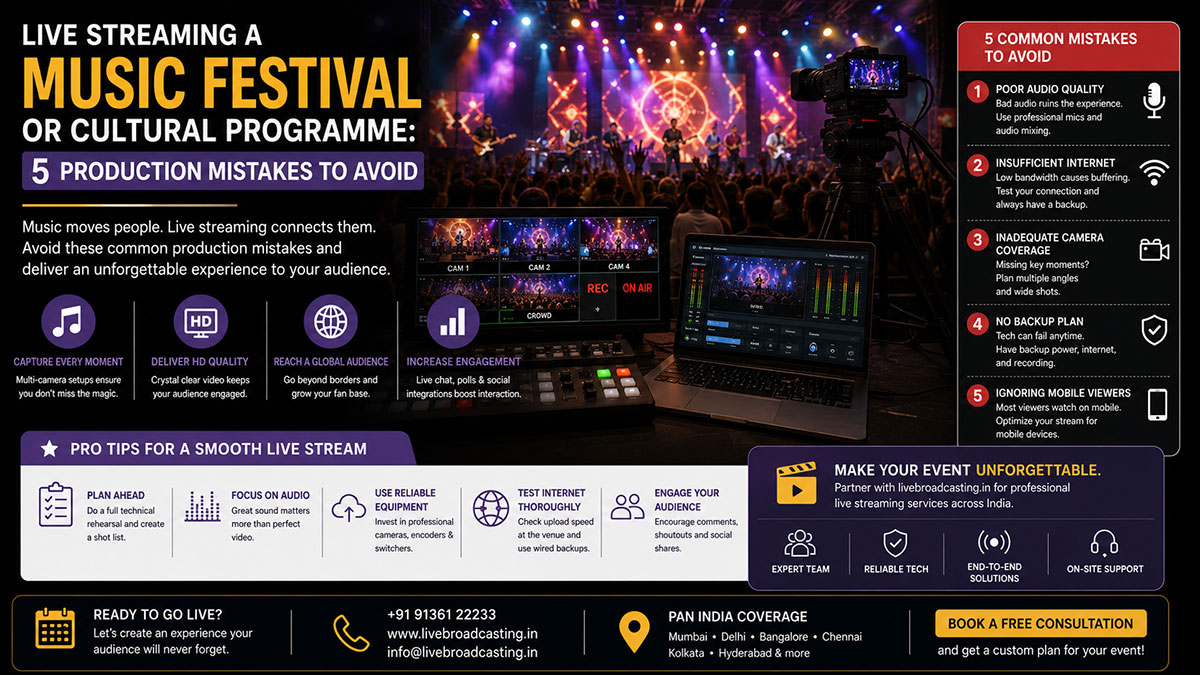
India’s cultural calendar is extraordinary — from classical Hindustani and Carnatic performances at the Sawai Gandharva Bhimsen Festival in Pune to EDM festivals across Goa, from Durga Puja pandal events in Kolkata to Bharatanatyam arangetrams in Chennai. Live streaming these events to audiences who cannot attend in person is now a natural extension of the event experience.
Mistake 1 — Taking Audio Directly from the PA System Without Treatment
The most common and most damaging mistake in music event streaming is plugging a direct feed from the main PA system into the streaming encoder and assuming that this is your audio. The main PA system is mixed for the room — specifically optimised to fill the physical space. This mix sounds completely different through headphones or speakers at home.
The Solution — A Dedicated Streaming Mix
Professional streaming productions for music events use a separate audio engineer who creates an independent streaming mix using the same microphone and instrument feeds as the main PA, but mixed specifically for home listening.
Mistake 2 — Underestimating the Lighting Challenge
Outdoor music festivals in India involve extreme lighting conditions: bright afternoon sunlight, deep shade, the transition between the two as the sun sets, and then dramatic stage lighting after dark. Cameras set to automatic exposure struggle dramatically in festival environments.
The Solution — Manual Exposure and Dedicated Lighting Awareness
Professional camera operators shooting in festival conditions work entirely in manual exposure mode, making deliberate exposure decisions for each shot and scene.
Mistake 3 — Using Only One Camera for a Multi-Performer Event
A classical ensemble, a Bollywood dance troupe, a jazz quartet, or a Kathakali performance involves multiple performers in different parts of the stage. A single locked-off camera cannot capture the relationships between performers, the detail of expressive faces and hands, and the full visual scope of a cultural performance.
The Solution — Thoughtful Multi-Camera Coverage
Professional cultural event streaming uses a minimum of three cameras: a wide master shot, a medium shot following the lead performer or vocalist, and a third camera providing close-up detail. The director cuts between these angles to create a visual narrative that enhances the viewer’s understanding of the performance.
Mistake 4 — Ignoring Copyright and Music Licensing
Playing commercially licensed music during a live stream without the appropriate performing rights licences can result in the stream being muted automatically by platform algorithms or taken down entirely. India’s performing rights landscape involves licences from organisations including PPL India and IPRS.
The Solution — Proactive Licence Verification
Before confirming a streaming production for any event involving commercially licensed music, professional streaming companies raise the licence question with the event organiser. Original compositions performed live by the composer or band typically do not require streaming licences.
Mistake 5 — Failing to Plan for Programme Changes and Overruns
Festival programmes are fluid. Performers run over time. Technical delays occur. Artists change their set at the last minute. An inexperienced streaming team with a fixed production plan is caught completely off-guard when the programme changes.
The Solution — Flexible Production Planning and Good Communication
Professional streaming teams treat the published festival programme as a guide, not a contract. They maintain constant communication with the event production team and stage manager throughout the event, updating cues, graphics, and camera plans in real time as the programme evolves.
Frequently Asked Questions
Q: Can I live stream a music concert on YouTube without copyright issues?
It depends entirely on whether the music performed is original, licensed for streaming, or covered by a blanket platform licence. Original compositions by the performing artists generally have no streaming licence issues.
Q: How many cameras are needed for a music festival live stream?
A minimum of three cameras is recommended: a wide master shot, a medium performance shot, and a close-up detail shot. Large multi-stage festivals use six or more cameras per stage.
Q: What is the best way to capture audio for a classical music live stream?
A dedicated streaming audio mix — separate from the main PA mix — is the professional standard, created by a dedicated streaming audio engineer optimised for home listening.
