
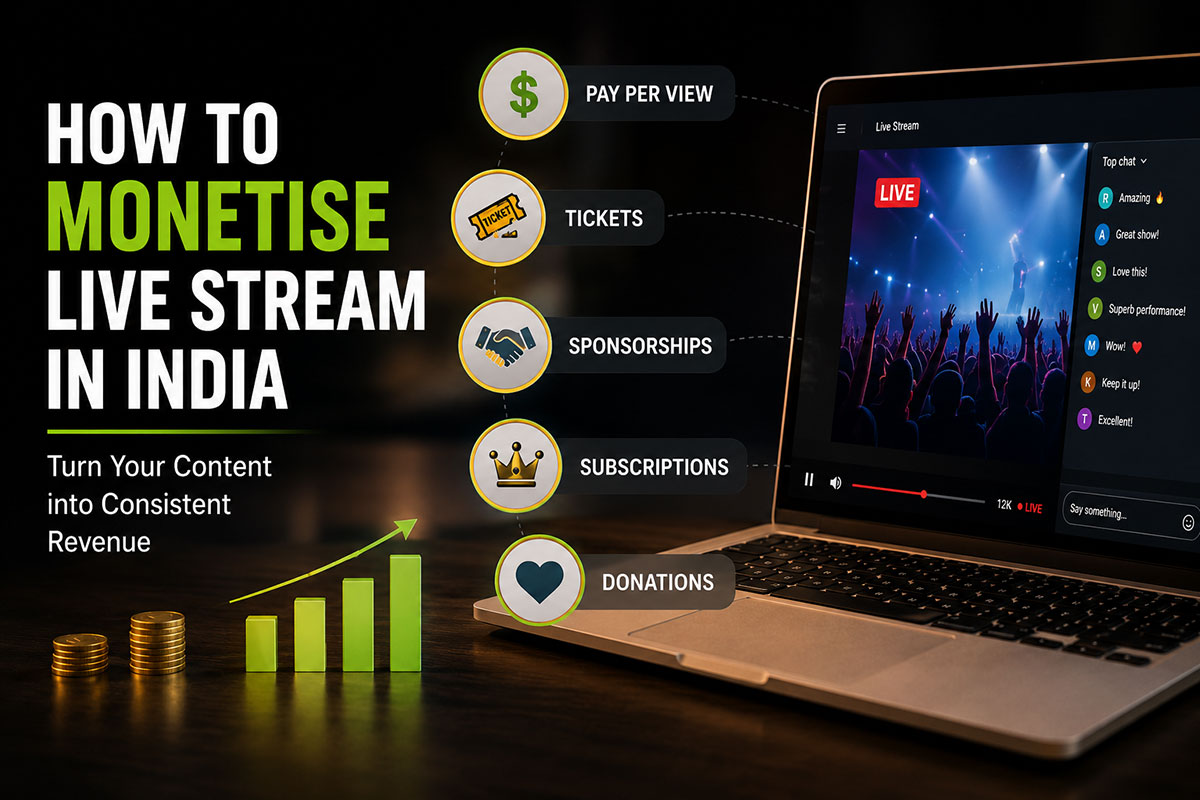
For years, live streaming in India was treated purely as a marketing cost — a way to extend reach, not a way to generate revenue. That’s changing fast. Content creators are running paid workshops, institutions are running ticketed convocations for out-of-town families, and event organizers are selling pay-per-view access to conferences and festivals that would otherwise require expensive travel. If you’re already investing in a stream, the question worth asking is: could this stream pay for itself, or even turn a profit?
This guide covers the realistic monetisation models available to Indian event organizers and creators today, and what infrastructure each one requires.
Model 1: Pay-Per-View Ticketing
The most direct monetisation model: viewers pay a fee to access the stream, either through a dedicated ticketing platform or a paywalled page on your own website. This works well for:
- Music festivals and concerts with a national fanbase larger than any single venue can hold
- Educational webinars and paid workshops
- Religious and cultural events with a diaspora audience willing to pay for a premium, ad-free viewing experience
The key infrastructure requirement is a secure, authenticated stream — meaning the video isn’t simply posted to an open YouTube link, but delivered through a gated player that verifies payment before granting access.
Model 2: Sponsor-Funded Streaming
Rather than charging the viewer, the event or creator sells visibility to sponsors, who fund the production cost in exchange for logo placement, verbal mentions, and on-screen branding. This model works particularly well for:
- Sports tournaments and cricket matches, where sponsor logos in the score overlay guarantee screen time (see our cricket streaming guide)
- Corporate and community events where a title sponsor wants association with a well-produced, widely watched broadcast
The production quality bar is higher here, since sponsors are effectively paying for impressions — a shaky, single-camera stream doesn’t justify a premium sponsorship rate the way a multi-camera, graphics-rich broadcast does.
Model 3: Hybrid Free-Plus-Premium
Many organizers now run the core event free on YouTube or Facebook for reach and SEO value, while offering a premium tier — better camera angles, ad-free viewing, bonus content, or early access — for a paid audience. This is common for:
- Conferences that want free reach for brand awareness but premium access for paying delegates
- Educational institutions live streaming convocations free for general public, while offering premium multi-cam access to families who couldn’t attend in person
Model 4: Repurposed VOD Sales
The live moment isn’t the only monetisable asset. A well-produced stream becomes a video-on-demand library entry that can be sold on a subscription or one-time-purchase basis long after the live event ends — turning a single production cost into a recurring revenue line, particularly effective for educational content, masterclasses, and cultural performances.
What Infrastructure Monetisation Actually Requires
Regardless of which model you choose, monetised streaming demands a higher reliability bar than a free community stream, because a paying viewer who experiences a dropped stream is a refund request, a public complaint, or a lost repeat customer. This means:
- Redundant connectivity (bonded 4G/5G, backup internet lines) so a single connection failure doesn’t kill the paid stream
- Multi-bitrate delivery, so viewers on slower connections still get a watchable stream rather than a demand for a refund — see our guide on multiple bitrate delivery
- A dedicated technical operator monitoring the stream live, not an unattended encoder
Getting Started
If you’re currently treating your live stream purely as a cost center, it may be time to reassess. Whether it’s a ticketed workshop, a sponsor-backed tournament, or a hybrid conference model, the right production partner can help structure the technical delivery around the revenue model, not just the event logistics.
Discuss Monetisation Options for your next stream and find out which revenue model fits your audience and content type.
