
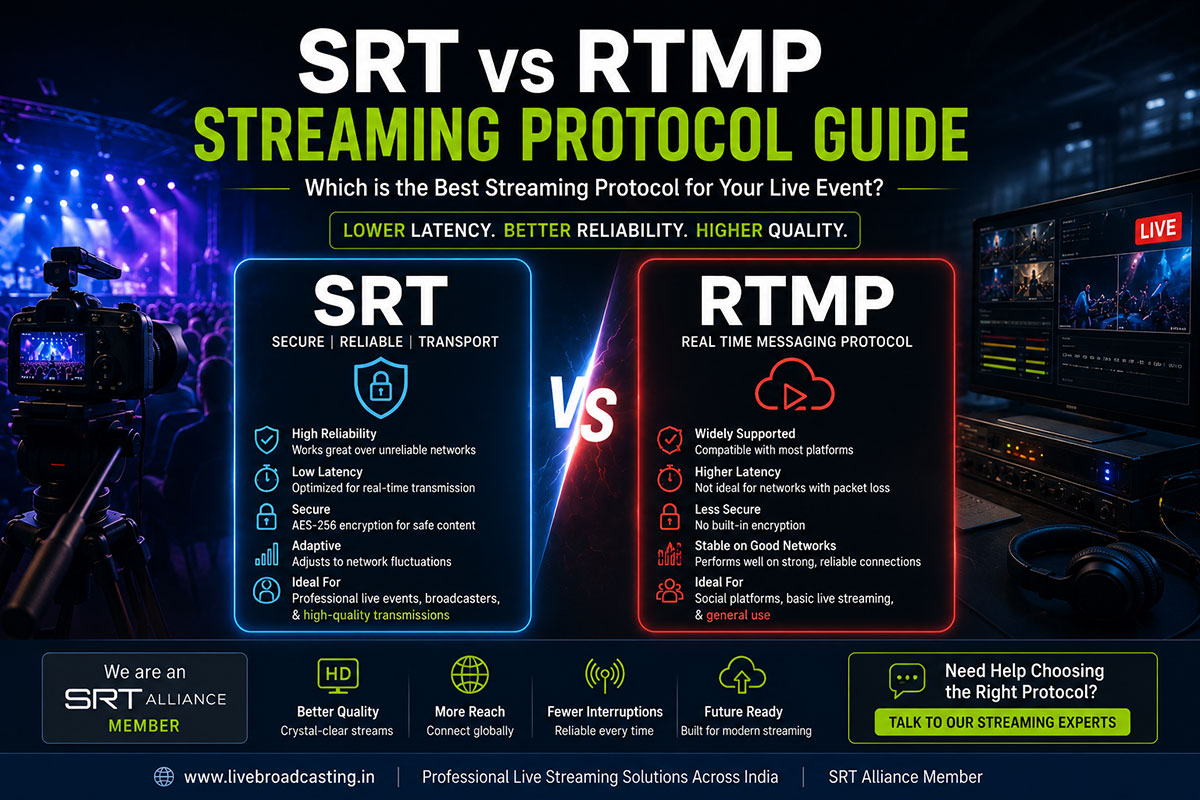
Behind every live stream, a transport protocol is quietly deciding whether your feed survives a network hiccup or drops mid-broadcast. For event organizers this detail is invisible — until the stream buffers during the CEO’s keynote. For AV professionals and IT managers making the technical call, the choice between RTMP and SRT has real consequences for latency, reliability, and security. This guide breaks down both protocols plainly, without vendor bias, so you can make the right call for your next event.
RTMP: The Legacy Standard
Real-Time Messaging Protocol (RTMP) has been the default transport protocol for live streaming for well over a decade. It’s supported by virtually every encoder and every major platform — YouTube, Facebook, and Twitch all still accept RTMP ingest. Its strengths are familiarity and universal compatibility.
Its weaknesses, however, are increasingly hard to ignore:
- No native packet-loss recovery. RTMP runs over TCP, which means a lost packet on a congested network causes a retransmission delay — the visible stutter or freeze viewers associate with “bad Wi-Fi.”
- Weak encryption support, making it a poor default for content requiring confidentiality, such as investor briefings or product reveals under embargo.
- Increasing platform deprecation risk — several major platforms have signaled long-term RTMP sunset plans in favor of newer ingest protocols.
SRT: Built for Unpredictable Networks
Secure Reliable Transport (SRT) was developed specifically to solve RTMP’s core weakness: performance over unreliable, public internet connections — precisely the conditions common at Indian event venues, from hotel ballrooms with congested Wi-Fi to outdoor grounds relying on mobile data.
SRT’s core advantages:
- Packet-loss recovery in real time, using forward error correction and retransmission techniques that patch gaps in transmission before they become visible stutters.
- AES encryption built into the protocol itself, not bolted on — critical for AGM broadcasts, board meetings, and any content with confidentiality requirements.
- Lower, more consistent latency, which matters enormously for interactive events with live Q&A, where a several-second delay between question and answer feels broken to viewers.
- Network bonding compatibility — SRT works well alongside bonded cellular connections, which is why it has become the default protocol for field production at venues without reliable fixed-line internet.
Why This Isn’t Just a Technical Footnote
For IT managers evaluating a streaming vendor, the protocol question is really a proxy for a bigger one: does this vendor understand modern broadcast infrastructure, or are they running consumer-grade tools? A vendor’s SRT capability — and ideally, formal SRT Alliance membership — is a reliable signal of technical seriousness, the same way TLS 1.3 support signals a serious web infrastructure provider.
When RTMP Is Still Fine
To be fair to RTMP: for low-stakes, single-platform streams over a stable venue internet connection — a routine internal town hall on a reliable office network, for instance — RTMP remains perfectly workable, and switching to SRT purely for its own sake adds complexity without benefit. The decision point is really about network reliability and content sensitivity, not protocol prestige.
A Simple Decision Framework
Bringing This Into Your Event Planning
If you’re evaluating streaming vendors for an upcoming AGM, product launch, or field production event, ask specifically what protocol they’ll use for ingest and why — the answer tells you a lot about how the rest of the technical stack is built. This same reliability discipline is what underpins our approach to Multiple Bitrate delivery for viewers on inconsistent mobile networks.
Ask Us About SRT Streaming if your next event involves confidential content, unreliable venue connectivity, or an audience that simply can’t afford to see a buffering wheel.
