
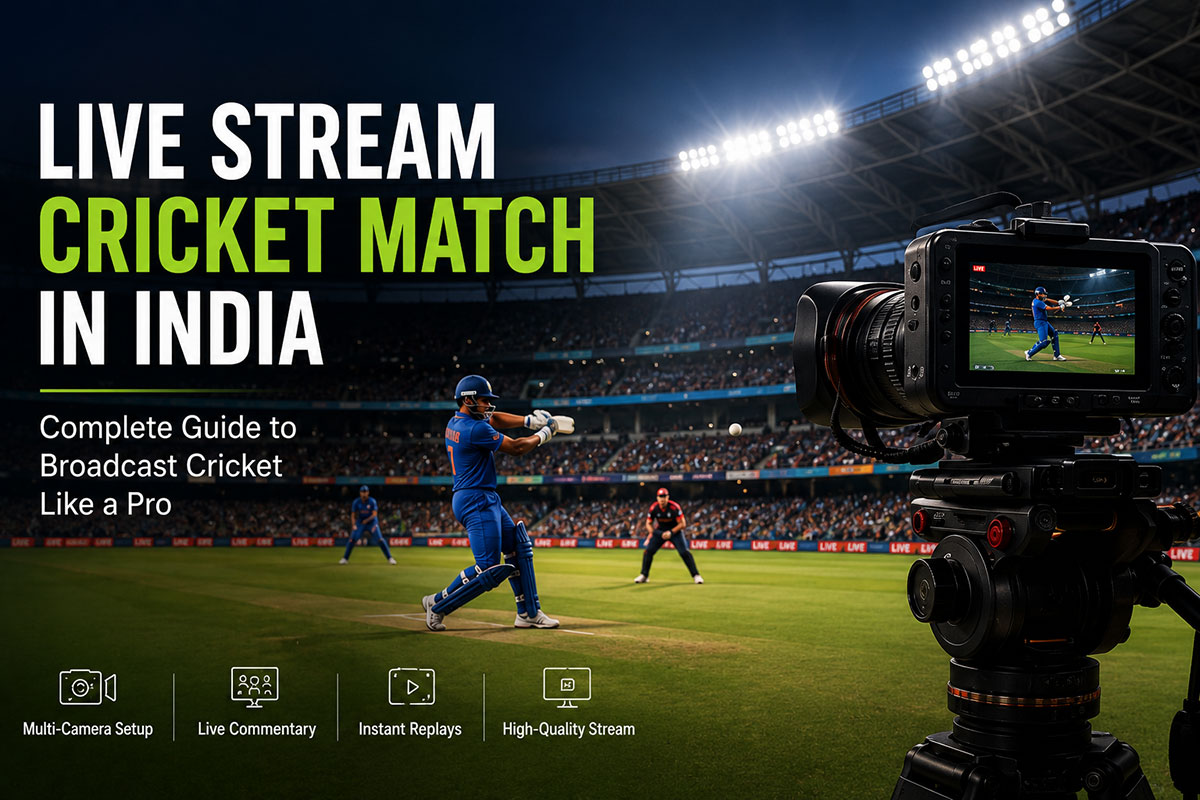
Cricket is not just India’s most popular sport — it is its most recorded sport. Every gully tournament, corporate league, school championship, and club match now has an audience expecting a broadcast, not just a scoreboard update on WhatsApp. Yet most amateur and semi-professional cricket in India still goes unstreamed, purely because organizers assume they need IPL-level infrastructure to put a match online. They don’t.
This guide breaks down exactly what’s needed to live stream a cricket match in India — from a single-camera club fixture to a multi-camera corporate tournament final — and how to do it without a broadcast-industry budget.
Why Cricket Streaming Demand Is Exploding
Corporate cricket leagues, gully cricket tournaments, school and college championships, and regional club matches have multiplied over the last few years, driven by workplace engagement budgets and a post-pandemic appetite for community sport. Parents want to watch their child’s school final from the office. A company’s HR team wants footage of the annual inter-department tournament for the next town hall. Sponsors want proof of visibility. All of this converts a “nice to have” into a genuine commercial requirement for event organizers.
Camera Angles That Actually Matter for Cricket
Unlike a corporate town hall where a single wide shot suffices, cricket has a specific visual grammar that viewers expect, even at an amateur level:
- Bowler’s-end wide shot — the primary camera, capturing the full pitch and both ends.
- Non-striker/square-leg angle — used for boundary shots and run-outs.
- Behind-the-stumps close angle — critical for LBW and stumping moments, even in non-DRS matches, because viewers expect the visual even if there’s no technology behind it.
- Boundary-line handheld or gimbal camera — for celebration shots, crowd reaction, and player interviews between overs.
A two-camera setup (bowler’s end + square leg) covers 80% of viewer expectations for club-level cricket. Three cameras with a switcher unlocks broadcast-quality replays.
Commentary: The Difference Between a Recording and a Broadcast
The single biggest quality jump for cricket streaming isn’t more cameras — it’s commentary. A stream with even one enthusiastic, reasonably informed commentator feels like a broadcast. A silent stream with only ambient stadium noise feels like surveillance footage. For corporate and club tournaments, many organizers use a former player, a sports-inclined employee, or a local college commentator rather than hiring a professional broadcaster — it keeps costs low while adding the layer that actually retains viewers.
Handling Overlays: Score, Overs, and Sponsor Branding
A basic scoreboard overlay (score, overs, required run rate) transforms viewer comprehension instantly, especially for viewers dipping in and out of the stream on mobile. For corporate tournaments, this overlay real estate also doubles as sponsor visibility — logo placement in the score bug is one of the most requested add-ons by tournament sponsors, since it guarantees screen time regardless of match events.
Connectivity: The Real Challenge of Ground-Level Streaming
Most cricket grounds — school fields, corporate campuses, club grounds — were never built with broadcast connectivity in mind. This is where amateur streaming attempts usually fail: a single mobile hotspot buffers under the load of a two-hour continuous stream. Professional setups solve this with bonded 4G/5G connections that combine multiple network signals into one stable upload feed, ensuring the stream survives even patchy ground connectivity.
Multi-Platform Delivery for Maximum Reach
A cricket stream performs best when it’s not locked to a single platform. Simulcasting to YouTube Live reaches the searchable, embeddable audience; Facebook and Instagram reach the community and family audience; and for larger tournaments, a dedicated multicam production adds replay value that keeps viewers on the stream longer between overs.
Budgeting for a Cricket Match Stream
A single-day club or corporate match with a two-camera setup, basic score overlay, and commentary sits comfortably within most CSR or HR event budgets — far below what most organizers initially expect, and well below the cost of hiring a dedicated production agency for a one-off shoot.
Ready to Stream Your Match?
Whether it’s a corporate league final or a school championship, cricket streaming doesn’t need to be complicated to be professional. Get a Sports Streaming Quote and find out what setup fits your ground, your budget, and your audience.
