
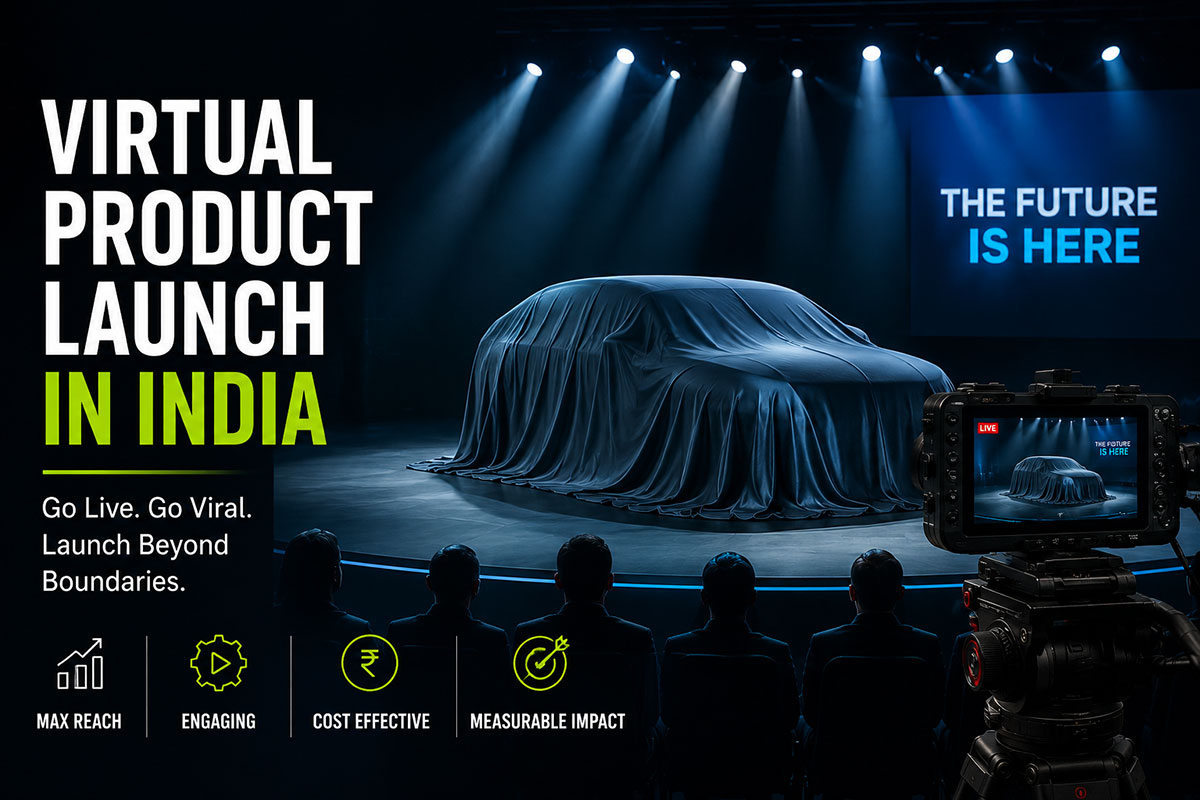
An in-person product launch reaches the people in the room. A virtual, live-streamed product launch reaches every retailer, distributor, journalist, influencer, and consumer who couldn’t be in the room — simultaneously, and at a fraction of the per-attendee cost of a physical event. For FMCG brands rolling out a new SKU nationally, auto brands revealing a new model, or tech companies unveiling a product, the live stream isn’t a backup to the physical event anymore — for many brands, it is the event, with the physical room simply serving as the stage set.
This guide covers what separates a forgettable virtual launch from one that gets clipped, shared, and covered by press the next morning.
Why “Virtual” Doesn’t Mean “Lower Production Value”
The biggest mistake brands make with virtual launches is treating the stream as an afterthought bolted onto an in-person event — a static camera pointed at a stage from the back of the room. Viewers who weren’t physically present have zero tolerance for a flat, single-angle recording; they compare it, consciously or not, to the launch videos of global brands they’ve seen on YouTube. A virtual launch needs to be directed — multiple camera angles, cut in real time, with graphics and product close-ups — not just recorded.
The Anatomy of a Launch That Gets Shared
Product reveals that go viral share a common structure, regardless of category:
- A build-up sequence before the reveal — teaser graphics, countdown, or a short narrative that creates anticipation rather than jumping straight to the product.
- A single, unmistakable “reveal moment” — lighting, camera movement, and audio cued precisely to one instant, since this is the ten-second clip that gets cut out and shared independently of the full stream.
- Immediate product close-ups from multiple angles, giving press and influencers usable B-roll without needing a separate shoot.
- A live Q&A or media interaction segment immediately after, so journalists can get soundbites without a separate briefing.
Simulcasting: One Launch, Every Platform, Zero Extra Shoots
A launch stream should be delivered simultaneously across YouTube, Instagram, Facebook, and LinkedIn (for B2B or auto/tech launches), so the audience — retailers on LinkedIn, consumers on Instagram, and press on YouTube — each experiences the launch on their preferred platform without the brand running separate shoots for each. This single-source, multi-platform approach is precisely what Simulcast production is built for.
3D Animation and Motion Graphics: The Differentiator
For tech and auto launches especially, motion graphics and 3D product renders inserted live into the broadcast — exploded-view animations of a new engine, rotating 3D models of a device — are what separate a premium launch from a basic one. This is increasingly table stakes for category leaders, and it’s covered in more depth in our 3D animation for live events guide.
Handling the Press: Media Feeds and Clean Signal Outputs
Product launches with journalist attendance (physical or remote) typically require a clean program feed — a broadcast-quality signal without on-screen graphics — delivered directly to press via SRT or a dedicated link, so news channels and digital publications can pull footage without watermarks. This is a common ask our team fields, and it connects directly to protocol choices covered in our SRT vs RTMP guide.
Turning the Launch Recording Into a Retail and Sales Asset
Once the live moment passes, the recording becomes a sales tool: cut into shorter product-explainer clips for the retail sales team, repurposed into paid social ads, and archived as VOD for the brand’s website product page — where prospective buyers who missed the live reveal can still watch the exact moment of unveiling.
