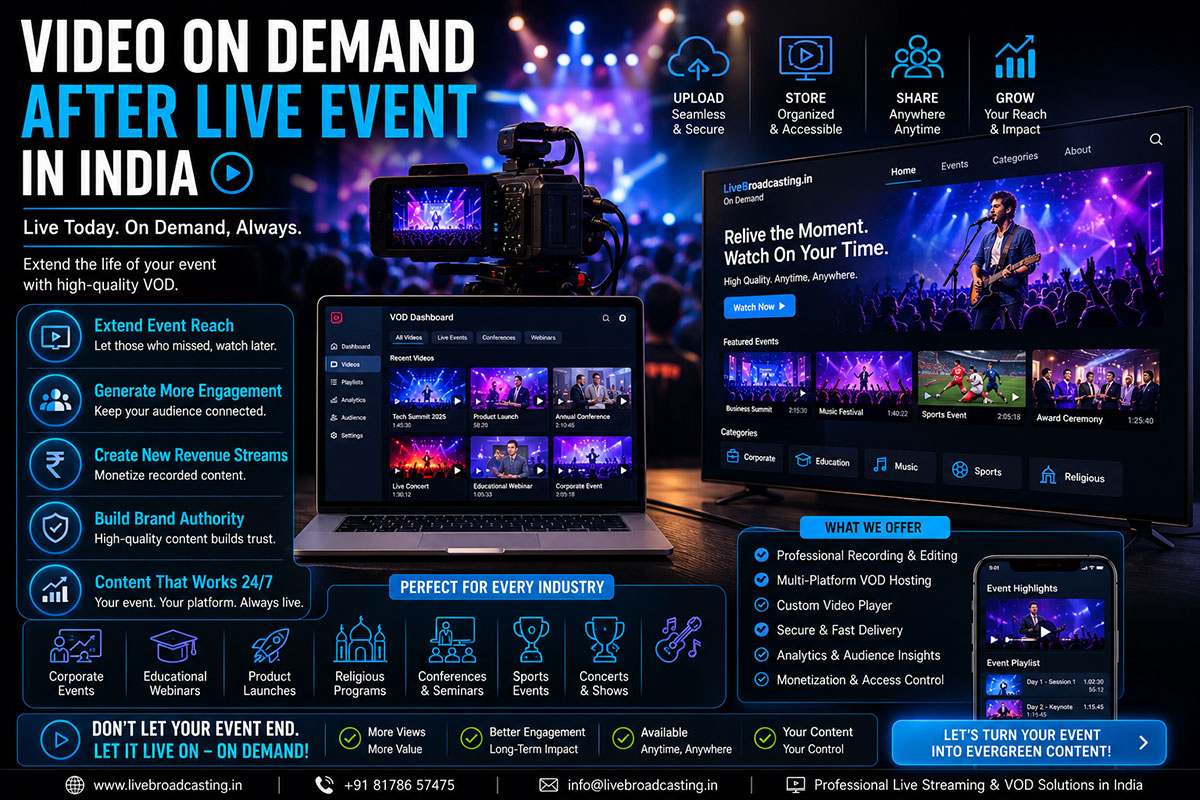
Most event organizers treat the live stream as the entire deliverable — the moment the event ends, the recording gets uploaded somewhere, forgotten, and never actively used again. This is, quantifiably, a waste of production spend. A live stream that cost real money to produce contains dozens of hours of usable footage, and without a deliberate VOD (video-on-demand) strategy, nearly all of that value evaporates the day after the event.
This guide explains why VOD deserves a place in your event planning from day one, not as an afterthought.
The Core Insight: Your Live Audience Is a Fraction of Your Total Audience
For almost every event category — corporate town halls, product launches, cultural performances, educational seminars — the number of people who watch live is a small fraction of the number who would watch the recording afterward, on their own schedule, if it were easy to find and well-packaged. A live stream watched by 500 people during the event can realistically be watched by several times that number over the following months as a VOD asset, provided it’s properly hosted, titled, and promoted.
VOD as a Lead-Generation Asset, Not Just an Archive
The most underused version of VOD is as an active part of the sales and marketing funnel, not a passive archive:
- Gated VOD access (email required to watch) turns a recorded webinar or product launch into an ongoing lead-generation tool, months after the live event
- Embedded VOD on service/product pages gives prospective clients social proof and context exactly where they’re already making a purchase decision
- VOD segmented into chapters (via timestamps or clips) lets viewers jump straight to the section relevant to them — a huge factor in whether they finish watching or bounce
Repurposing: Cutting One Recording Into Many Assets
A well-shot live event recording is raw material for dozens of downstream assets:
- Short-form clips for Instagram Reels, YouTube Shorts, and LinkedIn — pulled from the highest-engagement moments of the live stream
- A highlight reel (2–3 minutes) for the next event’s promotional materials
- Full-session VOD for attendees who want the complete context, especially useful for educational and conference content
- Audio-only extraction for a podcast feed, extending reach to an audience that consumes content while commuting
This same logic underpins our Podcast and Video Editing services — the live event is the raw capture; the edited outputs are where much of the ongoing value actually lives.
SEO Value: VOD Content That Keeps Working
Unlike a live stream, which exists only in the moment, a properly titled and described VOD upload on YouTube continues generating organic search traffic for months or years — particularly for educational, religious, and cultural content where evergreen search demand (a specific ritual explanation, a masterclass topic, a recurring festival) continues well beyond the live date. This turns a single event production cost into a long-tail organic traffic asset, the same durable-content logic covered in our guide on sustained SEO for heritage and cultural content.
What VOD Infrastructure Actually Requires
To capture this value, a few production decisions need to be made before the event, not after:
- Recording in the highest usable resolution, even if the live stream itself is delivered at a lower bitrate for bandwidth reasons
- Clean chaptering during the event (marking key moments in real time) so post-production editing is fast rather than requiring a full re-watch
- A dedicated VOD hosting and access strategy decided in advance — gated, embedded, or open — rather than “we’ll figure it out after”
Add VOD to Your Next Event Package
If your last few events ended with the recording sitting unused in a folder, there’s a straightforward fix. Add VOD to Your Package and start treating your event recordings as an ongoing asset instead of a one-time expense.
